

What Nerves Does C3, C4, C5 Makeup?
Overview
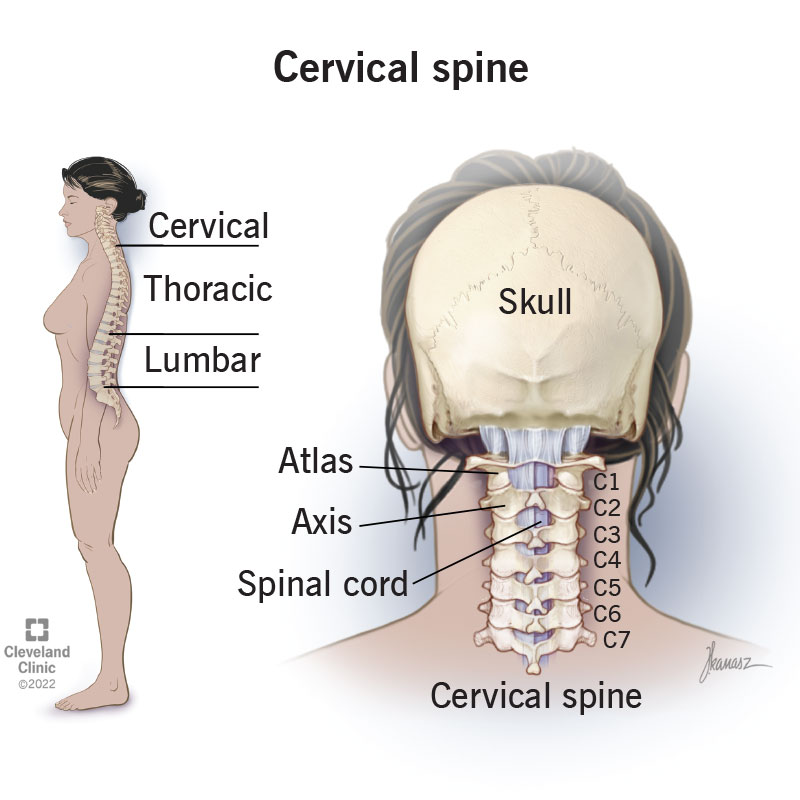
What is the cervical spine?
Your cervical spine — the cervix area of your spine — consists of vii stacked bones chosen vertebrae. The first 2 vertebrae of your cervical spine are unique in shape and function. Your first vertebra (C1), besides called the atlas, is a ring-shaped bone that begins at the base of operations of your skull. Information technology's named after Atlas, of Greek mythology, who held the world on his shoulders. The atlas holds your head upright. Your 2d vertebra (C2), also chosen the axis, allows the atlas to pivot against it for the side-to-side "no" rotation of your head.
Your seven cervical vertebrae (C1 to C7) are connected at the back of the bone by a type of joint (called facet joints), which let for the forward, backward and twisting motions of your neck.
Your cervical spine is also surrounded by muscles, nerves, tendons and ligaments. "Shock-absorbing" disks, called intervertebral disks, are positioned between each vertebra. Your spinal cord runs through the center of your entire spine. Your spinal string sends and receives letters from your brain, which controls all aspects of your body's functions.
What does the cervical spine exercise?
Your cervical spine has several functions, including:
- Protecting your spinal string. The nerves of your spinal cord pass through a large pigsty (chosen the vertebral foramen) that passes through the center of all of your vertebrae — from the base of your skull through the cervical vertebrae, the thoracic (eye dorsum) vertebrae and ending between the beginning and second lumbar (lower back) vertebrae. Taken together, all the stacked vertebrae of your spine grade a protective central culvert that protects your spinal cord.
- Supporting your head and allowing motion. Your cervical spine supports the weight of your caput (boilerplate weight of x to 13 pounds). It also allows your head and neck to tilt forward (flexion), backward (extension), turn from side to side (rotation) or curve to one side (ear-to-shoulder; lateral flexion).
- Providing a condom passageway for vertebral arteries. Minor holes in cervical spine vertebrae C1 to C6 provide a protective pathway for vertebral arteries to carry claret to your brain. This is the simply section of vertebrae in the entire spine that contains holes in the os to allow arteries to pass through.
What are the other muscles and soft tissues in the cervix?
Other structures around or involving your cervical spine include the following:
Muscles supporting your cervical spine
The major muscles that attach to your cervical spine include:
- Sternocleidomastoid. This muscle, one on each side of your neck, runs from behind your ear to the forepart of your neck. Information technology attaches to your chest bone (sternum) and collarbone. This muscle allows you to rotate your head side-to-side and tilt your chin upward.
- Trapezius. This pair of triangular muscles extend from the base of your skull down your cervical and thoracic spine and out to your shoulder bract. They help tilt your head upward/move your neck backward, rotate your caput right or left or lift your shoulder blade.
- Levator scapulae. This muscle attaches to your first 4 cervical vertebrae and the height of your shoulder blade (scapula). It helps elevator your shoulder blade, bend your head to the side and rotate your caput.
- Erector spinae. Several muscles make up this muscle grouping. In your cervical spine area, these muscles help with posture, neck rotation and astern neck extension.
- Deep cervical flexors. These muscles run down the front of your cervical spine. They allow you lot to flex your neck forward neck and help go along your cervical spine stable.
- Suboccipital muscles. These four pairs of muscles connect the height of your cervical spine with the base of operations of your skull. They allow you to extend and rotate your head.
Ligaments of your cervical spine
Ligaments in your cervical spine connect bone to bone to help to keep your cervical spine stable. Three major cervical spine ligaments are:
- Inductive longitudinal ligament. This ligament extends from the base of your skull, down the front of the cervical vertebra. It stretches to resist astern neck motion.
- Posterior longitudinal ligament. This ligament starts at C2 and extends downward the back of your cervical vertebrae. It stretches to resist forrad neck motion.
- Ligamentum flava. These ligaments line the backside of the within opening of each vertebra where your spinal cord passes. These ligaments cover and protect your spinal cord from behind.
Disks in the cervical spine
Cervical disks are the "stupor cushion cushions" that sit down between each vertebra. A total of six disks are positioned between the seven cervical vertebrae (1 between ii vertebrae). In addition to cushioning against stresses placed on your cervix, the disks allow you to flex and rotate your head more than hands during action.
Fretfulness in the cervical spine
Viii pairs of spinal nerves exit through small-scale openings (foramen) between every pair of vertebrae in your cervical spine. They're labeled C1 through C8. They stimulate muscle motility in your neck, shoulder, arm and hand, and provide sensation.
- Cervical fretfulness C1, C2 and C3 control your forward, backward and side head and cervix movements. The C2 nerve provides sensation to the upper area of your head; C3 gives sensation to the side of your confront and dorsum of your head.
- Cervical nerve four controls your upwards shoulder motion and is one of the nerves that controls your diaphragm (musculus at the bottom of your rib cage that helps you breathe). C4 provides sensation for parts of your cervix, shoulders and upper arms.
- Cervical nerve 5 controls the deltoid muscles of your shoulders and your biceps. C5 provides sensation to the upper part of your upper arm downwardly to your elbow.
- Cervical nerve half dozen controls the extensor muscles of your wrist and is involved in the control of your biceps. C6 provides sensation to the thumb side of your forearm and hand.
- Cervical nerve 7 controls your triceps and wrist extensor muscles. C7 provides sensation to the back of your arm into your middle finger.
- Cervical nervus 8 controls your hands and gives sensation to the pinky side of your hand and forearm.
Spinal string
Your spinal cord is a bundle of nerve tissue that extends from the lower function of your brain to your body. It carries messages betwixt your brain and the muscles mentioned above.
Often Asked Questions
What diseases and disorders bear upon your cervical spine?
Many diseases and conditions issue from problems in the cervical spine and the surrounding soft tissues and nerves. These include:
- Cervical radiculopathy. This condition arises when a cervical nerve is pinched by cervical vertebrae. Yous may experience tingling, numbness, weakness and hurting. Symptoms may remain local or can spread to your entire arm, hand and fingers. Cervical radiculopathy is likewise called a pinched nervus or cervical nervus pinch.
- Neck pain . Neck pain is a mutual symptom of many unlike injuries and medical conditions. Common causes include degenerative conditions (osteoarthritis, spinal stenosis, herniated deejay, pinched nervus), whiplash, mental stress, physical strain, poor posture, growths (tumors, cysts, os spurs), meningitis, rheumatoid arthritis and cancer.
- Cervical degenerative disk affliction . Cervical degenerative disk disease occurs when the disks in your cervical spine wear down.
- Herniated deejay . This condition is a tear or leak to the disks that provide a cushion betwixt vertebrae. Intervertebral disks allow you to bend and move with ease.
- Bone spurs in your cervical spine (cervical osteophytes). Bone spurs are growths that occur on any of the seven vertebrae in your cervical spine.
- Cervical spondylosis . Cervical spondylosis, as well called arthritis of the neck, is the age-related slow degeneration of your disks and joints in your cervical spine
- Cervical spinal cord injury . A cervical spinal cord injury is an injury to your cervical vertebrae. Virtually spinal cord injuries are the result of a sudden, traumatic blow to the vertebrae.
- Cervical spinal fracture . A fracture to the bones of your spine can result from pinch (ofttimes from minor trauma in a person with osteoporosis) or be a outburst fracture (vertebra that'south crushed in all directions) or a fracture-dislocation (mostly from vehicle accidents or falls from heights).
- Cervical spinal cord compression (cervical spondylotic myelopathy ). This is a condition in which there'due south force per unit area on your spinal cord in the cervical expanse of your spine. 1 of the about common causes is wear and tear on the basic of your spine, a condition called osteoarthritis.
- Cervical stenosis . This condition occurs when your spinal culvert in the cervical spine surface area narrows. Less space inside your cervical spine reduces the corporeality of space bachelor for your spinal cord and nerves that co-operative off the spinal cord. A tightened space can cause your spinal cord or nerves to become irritated, compressed or pinched.
- Cervical spinal tumor and cancer. Tumors are abnormal growths of tissue inside your spinal column. They can either be noncancerous (benign) or cancerous (malignant).
- Meningitis. Meningitis is an infection of the meninges. The meninges are a protective lining around your brain and spinal cord.
- Osteomyelitis. Osteomyelitis is a bacterial or fungal infection of the bone, in this instance, the vertebrae of your spine. If left untreated, information technology can lead to the expiry of vertebrae.
How are diseases and weather condition of the cervical spine diagnosed?
First, your healthcare provider will gather your medical and medication history, ask you about your symptoms, perform a physical exam and order tests and imaging studies.
Tests and imaging may include:
- Computed tomography (CT) scan . This browse uses Ten-rays and computers to produce images that are very thin "slices" of the surface area nether examination. A CT scan can show the shape and size of your spinal canal, its contents and the bone effectually it. Information technology helps diagnose bone spurs, osteophytes, bone fusion and bone destruction from infection or tumor.
- Magnetic resonance imaging (MRI) . This test uses a large magnet, radio waves and a estimator to produce detailed images. This scan can reveal problems with your spinal string and fretfulness exiting the spinal column, spinal degeneration, disk herniation, infections and tumors.
- X-rays . X-rays create pictures of your basic and soft tissues, using a small-scale amount of radiation. Ten-rays tin show fractures, disk issues, spinal alignment issues and the presence of arthritis.
- Electromyogram (EMG) and nerve conduction studies. An EMG helps evaluate the health and role of nerves and muscles. A nerve conduction study measures how fast an electrical impulse moves through your nervus. These tests help determine ongoing nerve damage and the site of nerve compression.
- Myelogram . This imaging test examines the relationship betwixt your vertebrae and disks, outlines the spinal string and nerves exiting your spinal cavalcade. Information technology shows if such possible things equally a tumor, bone spurs or herniated disk are pressing against your spinal cord, fretfulness or nerve roots and causing hurting, numbness or weakness.
- 10-rays . 10-rays create pictures of your basic and soft tissues, using a minor amount of radiation. 10-rays can show fractures, disk bug, spinal alignment bug and the presence of arthritis.
How are cervical spine health issues treated?
Both nonsurgical treatment options and surgery are bachelor to treat many of the conditions that affect the cervical spine. The choice depends on the cause of the cervical spine result and its severity.
What are the nonsurgical treatment options for cervical spine conditions?
Your healthcare provider may starting time recommend less invasive approaches for cervix hurting that aren't caused past trauma or a tumor. Some common nonsurgical treatment options include:
- Balance.
- Ice or rut.
- A soft cervical collar. A collar helps support and immobilize your cervix.
- Fugitive strenuous or aggravating concrete activity.
- Physical therapy.
- Medications, including muscle relaxants, pain relievers (such equally acetaminophen) and anti-inflammatories (such as ibuprofen and naproxen).
- Steroid injections. 2 specific types of steroid injections may be considered for neck and/or arm pain. A cervical epidural block is a process in which the steroid is injected into the epidural space (the infinite next to the covering of youe spinal cord). Cervical facet joint block is a procedure in which the steroid is injected into the capsule (connective tissue covering) of the facet joint (the small joint at the summit and lesser of each vertebra that connects the vertebrae to permit move).
- Medical branch block and radiofrequency ablation. This procedure is considered in some cases of chronic neck pain. First, a local anesthetic is injected into the nerve that supplies the facet joint of the vertebrae. If your pain is relieved, the next pace is to make pain relief permanent. This is washed by dissentious your nerve with a technique called radiofrequency ablation. Pain relief lasts for months. If your nervus regenerates, the pain can return.
How do I know if I'thou a candidate for cervical spine surgery?
You may exist a candidate for cervical spine surgery if:
- Other treatments aren't helping.
- Symptoms involving your spine, artillery and/or legs are worsening.
- Yous're healthy enough to have surgery.
What surgical handling options are available for cervical spine conditions?
Common surgical approaches include:
Cervical spinal decompression surgery
Cervical spinal decompression surgery is a general term that refers to various procedures used to relieve symptoms caused by pressure, or compression, on your spinal cord or nerve roots. Nerve roots are the outset segment of a nerve that leaves your spinal cord through the small hollows betwixt the vertebrae. Common surgical techniques for decompression include:
- Cervical diskectomy. In this procedure, your surgeon removes a portion of a disk to relieve pressure level on the nearby nervus roots.
- Cervical laminotomy or laminectomy. In these procedures, your surgeon removes a small-scale part of the bony arches of the spinal canal, called the lamina. Simply a small section of the lamina is removed in a laminotomy. The entire lamina is removed in a laminectomy along with any os spurs, disk cloth and thickened ligament if needed. Removing the lamina increases the size of the spinal canal, which relieves pressure.
- Cervical foraminotomy or foraminectomy. Both of these procedures are performed to aggrandize the openings for the nerve roots to exit your spinal string by removing some bone in that area. In a foraminectomy, a big corporeality of bone is removed.
- Cervical corpectomy. In this surgery, your surgeon removes the body of the vertebra (the large front portion of the vertebra), likewise as the disk to salvage pressure level on the spinal cord. In some cases, this is followed past fusion of the vertebrae (permanently connecting two or more than vertebrae) to keep your cervical spine stable.
Cervical disk replacement surgery
Cervical disk replacement surgery involves removing a diseased cervical disk and replacing information technology with an bogus disk. The most common reason for this process is cervical disk degeneration.
Cervical spinal fusion
Cervical spinal fusion is surgery that permanently connects to one or more cervical vertebrae. The surgery eliminates the move betwixt vertebrae.
Functional electrical stimulation for spinal cord injury
Functional electrical stimulation for spinal string injury. This procedure uses small electrical impulses to activate specific muscles and nerves to restore function to your upper body muscles controlled by cervical nerves.
Is having minimally invasive cervical spine surgery a possibility?
Speak with your surgeon. In many cases, minimally invasive spine surgery is an choice. Compared to the one large incision through your skin with traditional open surgery, minimally invasive surgery is performed through i or more smaller incisions. Working through smaller incisions causes much less harm to muscles and soft tissues than a single long incision.
A note from Cleveland Clinic
Your cervical spine is the neck region of your spinal cavalcade or backbone. It consists of your kickoff seven bones (C1-C7). Other structures in or around your cervical spine are your intervertebral disks, spinal cord and nerves, muscles, tendons and ligaments. Your cervical spine supports the weight of your head and allows a wide range of head movement. Its circular surround of bone too protects your spinal cord. Many diseases and disorders can affect your cervical spine. Fortunately, many nonsurgical and surgical options tin can care for these weather condition.
Source: https://my.clevelandclinic.org/health/articles/22278-cervical-spine
Posted by: williamsoncaget1970.blogspot.com
0 Response to "What Nerves Does C3, C4, C5 Makeup?"
Post a Comment